

NetSingularity
NetSingularity
OSS TransformationCustomer Success Story · OSS Transformation · India

One platform to run a nationwide,
multi-vendor network

How one of India's largest neutral telecom infrastructure providers replaced a patchwork of siloed element managers with the NetSingularity OSS, unifying fault, performance, inventory, topology and service fulfilment across IP-MPLS, DWDM and legacy layers.

Sector:
Telecom Infrastructure
Network:
IP-MPLS · DWDM · Legacy
Vendors:
Cisco, Juniper, Nokia, Adva, Tejas, Ciena, ECI, Edgecore & more
Scope:
Unified OSS Software Suite
Approach:
Phased: IP-MPLS → DWDM → Legacy
Integrations:
ERP (Oracle) · HPSM · Multi-vendor EMS/NMS
~27,000
Devices unified
3
Network layers
15+
OEMs integrated
1M+
Events per day
54M
PM counters per hour
250
Concurrent operators

The Customer

A carrier-grade network at national scale

The customer is one of India's largest neutral telecom infrastructure providers: a national-scale public-sector operator running a pan-India optical backbone. It delivers connectivity and managed services to government, enterprise and retail customers nationwide. Behind that reach sits an enormously diverse network: IP-MPLS routing, DWDM optical transport and a large installed base of legacy switching, built over years from more than a dozen equipment vendors. Keeping it running meant operating each vendor's element manager on its own island, with no unified view of the whole.

The Challenges

Six pain points of a fragmented operations stack

Every vendor came with its own management system. Operators were stitching the network together by hand: slow, reactive, and blind to the end-to-end picture.

01Issue

Siloed visibility

Faults, performance, inventory and topology lived in separate vendor tools, with no single pane of glass across the network.

02Issue

Alarm overload

Tens of thousands of raw, uncorrelated alarms buried the real problems and overwhelmed the NOC.

03Issue

Reactive fault handling

Manual triage, manual ticketing and slow root-cause analysis meant longer outages and higher risk.

04Issue

Manual provisioning

Services were turned up device by device over CLI, which was error-prone, inconsistent and hard to scale.

05Issue

Fragmented inventory

No unified, real-time record of physical and logical resources or the service topology built on them.

06Issue

Scaling ceiling

Legacy tooling couldn't keep pace with a growing, multi-technology, carrier-grade network.

The Solution

The netSingularity OSS: one platform, full FCAPS + fulfilment

A single, cloud-native OSS that ingests from any vendor and delivers unified fault, performance, inventory, topology and catalog-driven service fulfilment across all three network layers.

Architecture

Built carrier-grade, open by design: Kubernetes-orchestrated microservices, a Kafka event backbone, and a multi-model data layer (relational, graph and time-series) engineered for 1M+ events per day and 54M performance counters per hour. Open, standards-based interfaces integrate cleanly with the operator's ERP (Oracle) and HPSM ticketing, so the OSS fits the existing operations landscape rather than replacing it.

  1. Fault Management

    Protocol-agnostic ingestion, inventory-enriched alarms, and multi-algorithm correlation (topology, parent-child, mass-outage and intermittent), with deduplication and automatic ticketing into HPSM.

  2. Performance Management

    Multi-vendor counter ingestion, a vendor-neutral KPI builder, node/time/hierarchical aggregation, dashboards, threshold alarms and on-the-fly analytics.

  3. Inventory & Discovery

    Automated multi-vendor discovery with OSPF/BGP/LLDP link mapping into a graph-based inventory, kept current by near-real-time reconciliation.

  4. Topology

    Unified logical and geographic views with end-to-end service visualization and drill-down from map to device to alarm.

  5. Service Fulfilment

    Catalog-driven, workflow-automated provisioning of L2VPN, L3VPN, VPLS, VLAN and Internet, with pre-checks, validation and automatic rollback.

  6. Customer Portal

    Self-service portal for service status, SLA visibility and ticket raising, extending OSS value to end customers.

One Consolidated View

Multi-vendor. Multi-domain. Multi-technology. One pane of glass.

The platform's core value: every layer, every vendor and every service the network runs on, normalized into one common model and one operational picture, instead of a dozen disconnected tools.

Domains

  • IP-MPLS
  • DWDM Optical
  • Legacy

Vendors

  • Cisco
  • Juniper
  • Nokia
  • Adva
  • Tejas
  • Ciena
  • ECI
  • Edgecore
  • D-Link
  • HFCL
  • + more

Technologies & Services

  • L2VPN
  • L3VPN
  • VPLS
  • VLAN
  • Internet
  • OSPF/BGP/LLDP
  • SNMP/Telemetry

netSingularity OSS: a single pane of glass

Common schema and vendor-neutral KPIs · unified inventory, topology, faults and performance · one console for the entire network

Order to Activation

Catalog-driven service order & provisioning

Service requests arrive from the customer self-service portal or northbound from the ERP (Oracle), and the LCM Orchestrator turns each one into a repeatable, automated flow: feasibility checks, activation across multi-vendor devices, and full lifecycle control from request to ready.

  1. 1

    Request

    Order raised via the customer portal or northbound from the ERP (Oracle).

  2. 2

    Catalog & workflow

    A reusable service template and provisioning workflow are selected for the order.

  3. 3

    Pre-checks

    Interface, neighbor, VLAN, MPLS and VRF feasibility validated before anything is pushed.

  4. 4

    Auto activation

    Configuration is pushed and activated across multi-vendor devices.

  5. 5

    Status & assurance

    Real-time status, with automatic rollback or retry on failure.

  • L2VPN
  • L3VPN
  • VPLS
  • VLAN
  • Internet
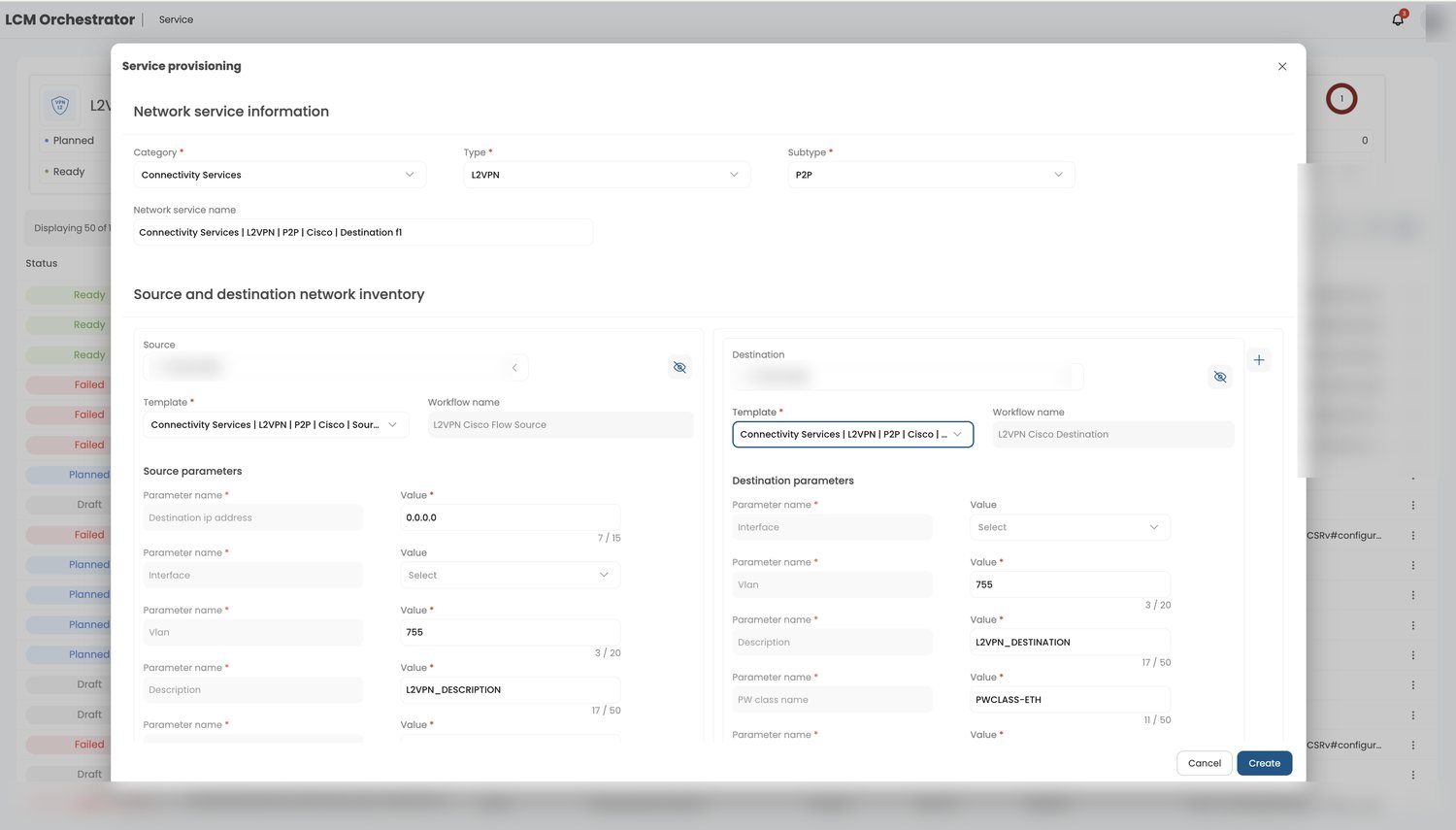
LCM Orchestrator service provisioning screen
Catalog-driven provisioning in the LCM Orchestrator: a Cisco L2VPN (P2P) built from a reusable template and workflow, with source/destination parameters, live service states (Ready / Planned / Failed) and built-in rollback. Customer-identifying data redacted.

The change: service turn-up moves from manual, device-by-device CLI to consistent, catalog-driven automation, with faster activation, fewer errors and full traceability across vendors and locations, and rollback to de-risk every change.

Results in the Field

What operators actually see

Three views carry the day-to-day work on the live network.

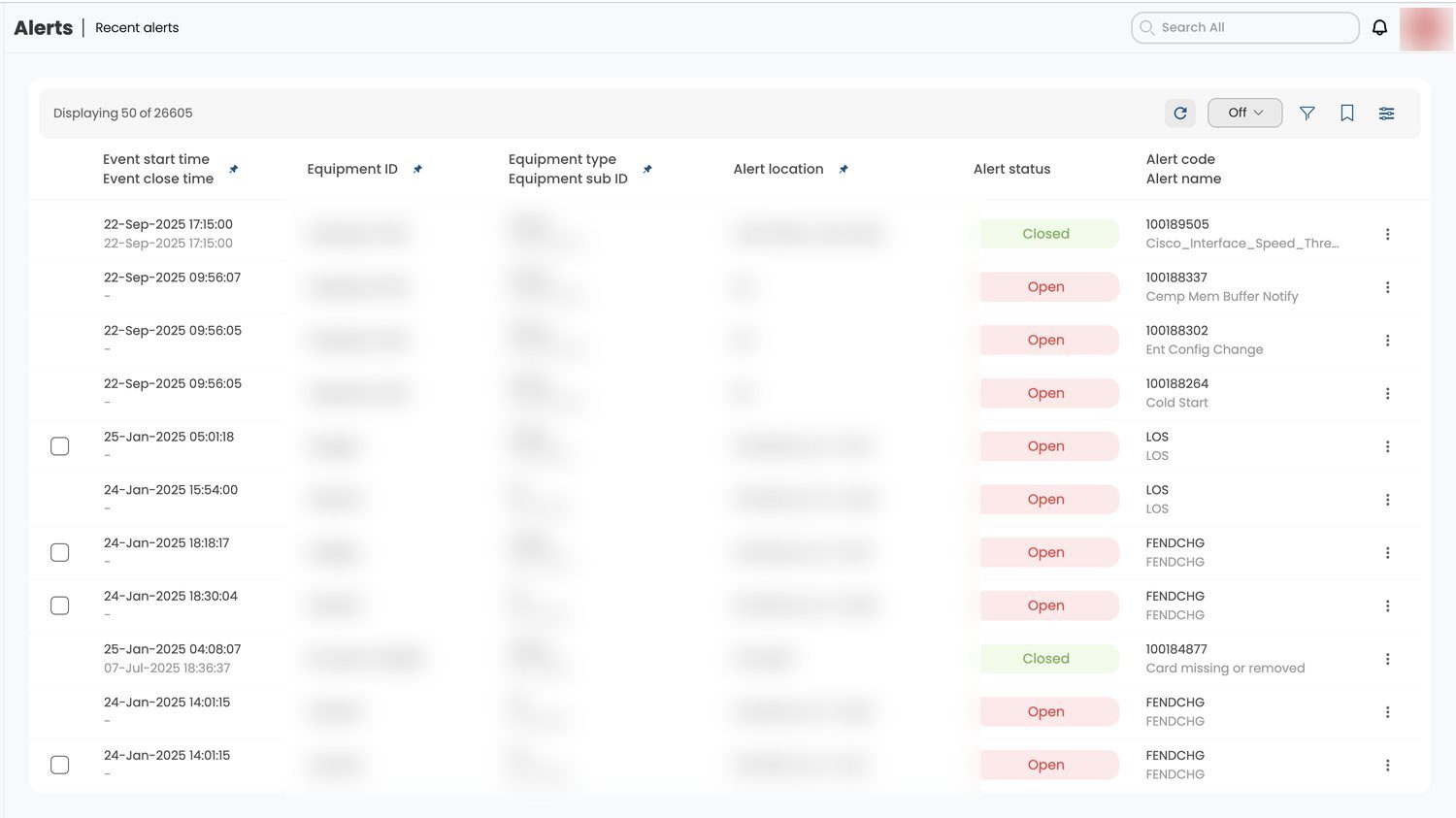
Fault Management alert monitoring console

Real-time fault console

A single monitoring screen tracks tens of thousands of alarms across routers, DWDM, ILA and OADM nodes, with live open/closed state, location and alarm code, so the NOC works from one correlated view instead of many.

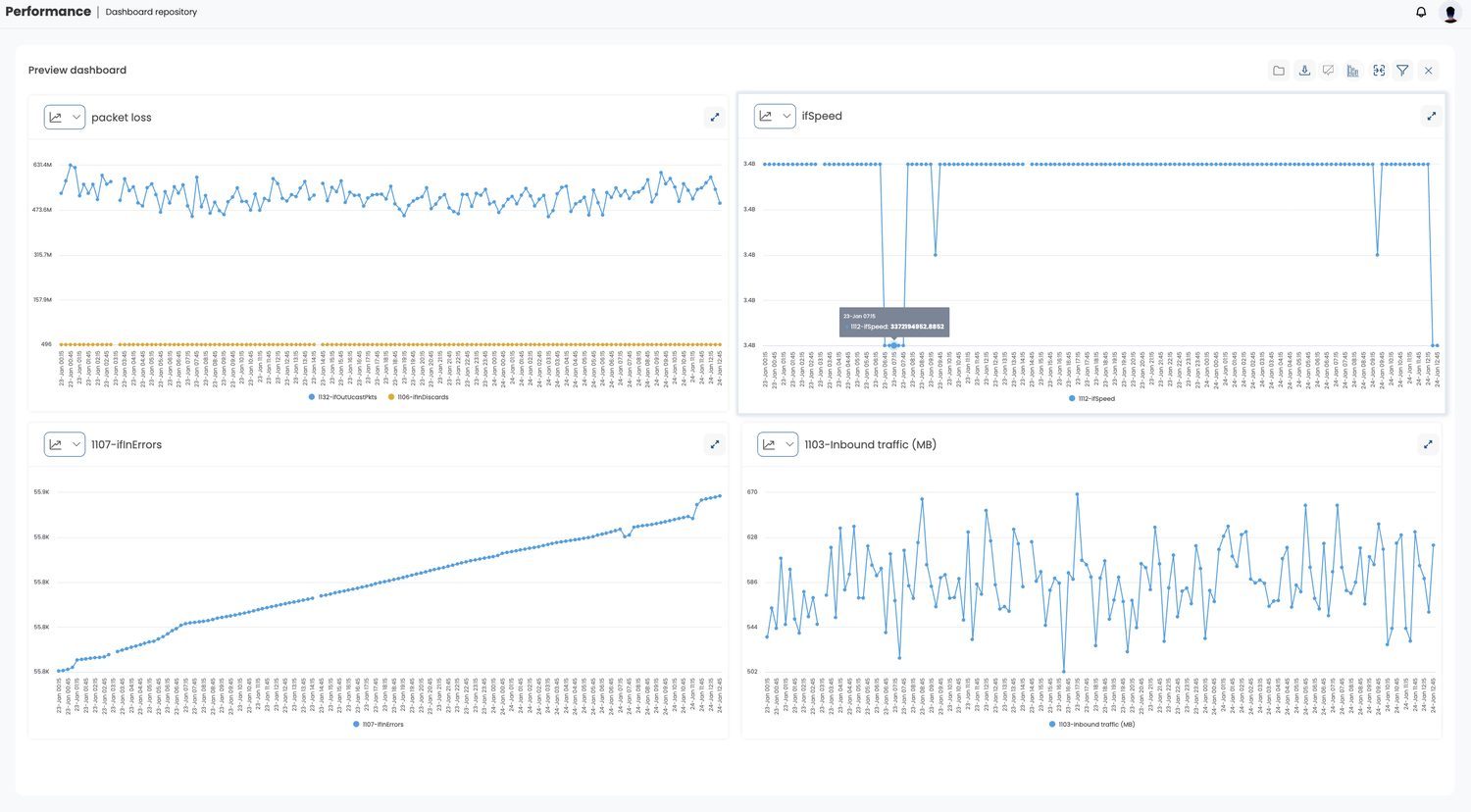
Performance KPI dashboard

Multi-KPI performance dashboards

Vendor-neutral KPIs such as packet loss, interface speed, errors, inbound traffic and more are rendered as interactive trends, turning raw counters into insight for troubleshooting and capacity planning.

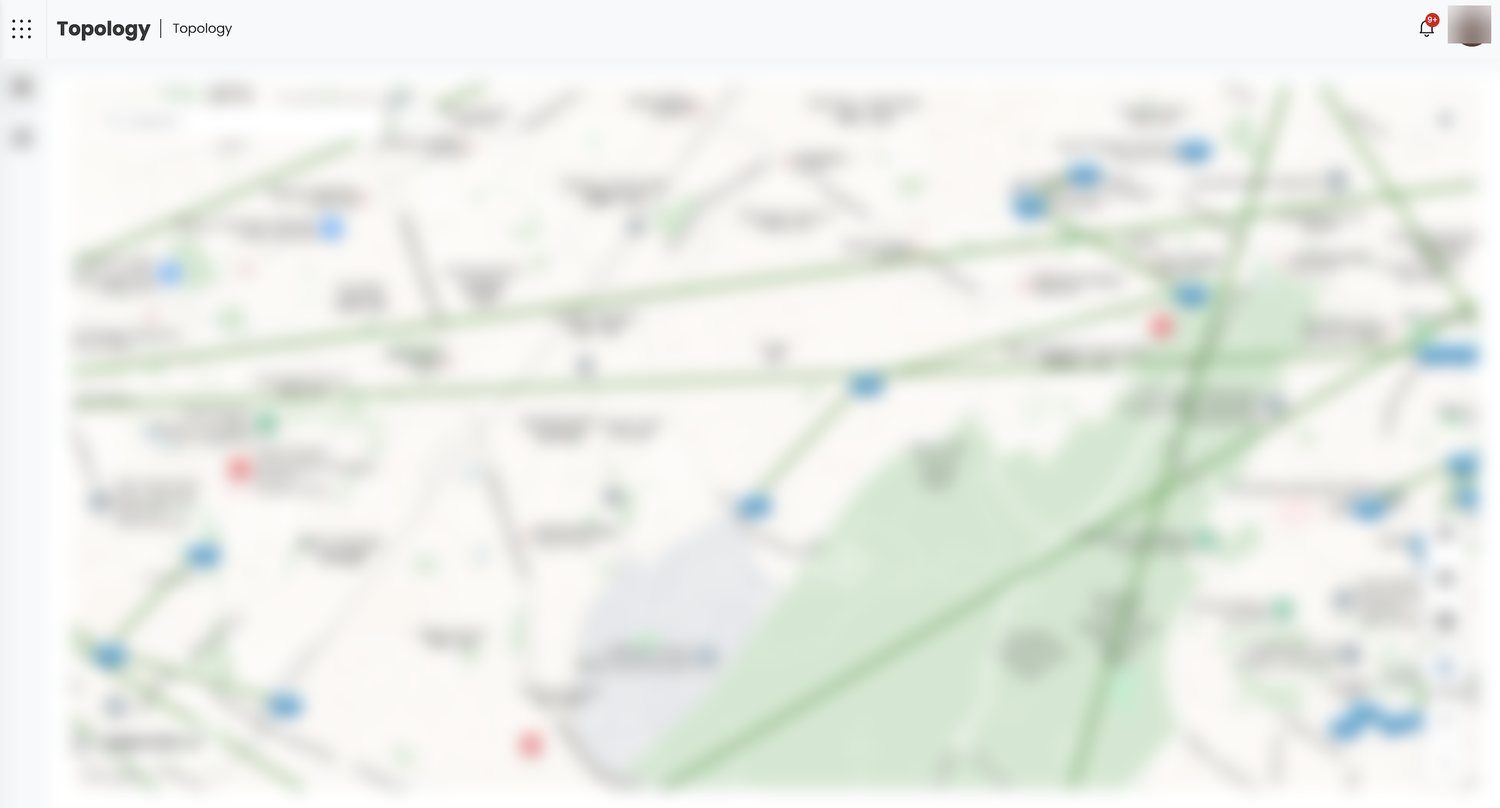
Geographic network topology map

Geographic network topology

Discovered nodes and links plotted on a live geographic map, giving operations an end-to-end, spatial picture of the network and its service paths at a glance.

The Impact

From reactive firefighting to proactive control

The same operations team, working a fundamentally better way.

DimensionBefore: siloed & manualAfter: unified & automated
VisibilityA separate EMS per vendor, with no unified viewOne pane of glass across ~27,000 devices and 3 layers
Alarm handlingAlarm floods with no correlation or deduplicationCorrelated incidents cut alarm noise and speed root-cause analysis
TicketingManual root-cause analysis and manual ticketingAutomatic incident-to-ticket into HPSM
Service turn-upCLI-driven, device-by-device provisioningCatalog-driven automation for 5 service types, with rollback
InventoryStatic, fragmented inventory recordsLive graph inventory plus geographic topology
ScalabilityTooling that couldn't scale with the networkCloud-native platform built to grow with the network
Faster

Fault resolution

Correlation, enrichment and auto-ticketing compress detection-to-resolution and shrink outage windows.

Quieter

NOC operations

Multi-algorithm correlation and deduplication surface the real problems and silence the noise.

Automated

Service turn-up

Catalog-driven provisioning replaces manual CLI work with consistent, repeatable, low-risk workflows.

Unified

Network visibility

Fault, performance, inventory and topology in one place, across every vendor and every layer.

Proactive

Capacity & planning

KPI thresholds, trends and analytics move operations from reacting to anticipating.

Future-ready

Scalable foundation

Cloud-native, highly available and open-standard, ready for the DWDM and legacy phases and beyond.

A single, open OSS that turns a fragmented, multi-vendor network into one observable, automatable system, giving operations the visibility and control to run at national scale.

Solution summary, NetSingularity OSS delivered for a national telecom operator

Unify your multi-vendor network operations

One cloud-native OSS for fault, performance, inventory, topology and catalog-driven fulfilment, ingesting from any vendor, integrating with the ERP and ticketing systems you already run.

More case studies

Service AssuranceIndia

AI-Powered RAN Fault Management, Delivered Fully On-Premises

A network of hundreds of thousands of sites generating ~1.25 crore alarms a day, handled by static correlation rules and manual RCA. Six coordinated AI capabilities turned that flood into unique actionable incidents, without a single byte leaving the operator's estate.

~60%~50%Tier-1 mobile operator, India
Read case study
Network RolloutCanada

Zero-Touch O-RAN Site Rollout at Nationwide Scale

O-RAN gives operators vendor choice, and with it more moving parts to coordinate on every site turn-up. One automation layer now carries planning data, field capture, provisioning, configuration and verification end to end.

<2 hrsZeroTier-1 telecom operator, Canada
Read case study

Customer identity withheld and referred to throughout as "one of India's largest neutral telecom infrastructure providers." Figures and screens are sourced from the NetSingularity OSS solution design; customer-identifying data redacted.